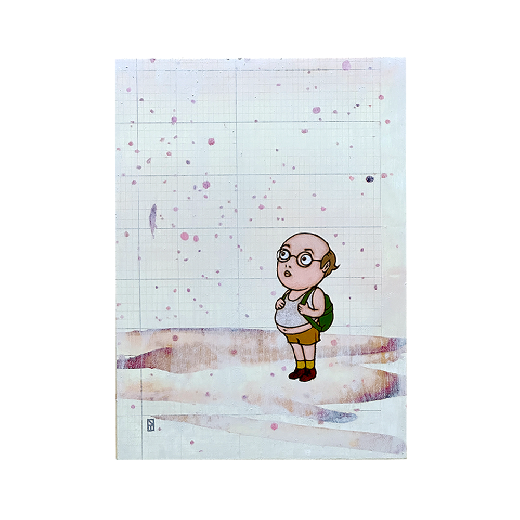
コンセプト
私たちは、自分たちが知覚できる世界を「現実」だと認識して生きています。しかし、宇宙に存在する生命や世界が、人間と同じ身体や知覚、同じ空間構造を持っているとは限りません。
本作は、人間には本来知覚することのできない「高次の存在」や「多次元的な宇宙」を想像し、架空の都市「VEYRA」と、そこで暮らす少女「ノイ」の日常を描いた作品です。
VEYRAの着想のひとつとなったのは、人間のような生命にとって極めて過酷な環境を持つ巨大なガス惑星です。明確な地表を持たず、私たちが当然のものとして認識している「地面」や「空間」という概念すら成立しない世界。
もし、そのような環境にも人間とは異なる次元や知覚を持つ生命が存在していたなら、彼らにとっての世界はどのように見えるのでしょうか。
画面内の都市空間には、複数の遠近法や空間構造が混在しています。建築物や道路、機械的な構造は都市として認識できる一方で、それぞれの空間は完全には整合していません。
これは、人間が高次の世界全体を知覚することができず、自分たちが理解可能な三次元的な断片としてしか世界を認識できない状態を想像したものです。
しかし、本作で描いているのは、未知の世界で起こる特別な出来事ではありません。
描かれているのは、ノイにとっての何気ない一日です。
私たちには異質に見える空間も、そこで暮らす彼女にとっては見慣れた街であり、日常そのものです。
「普通」と「異常」は絶対的なものではなく、どの視点から世界を見るかによって変化する。その認識の差異を本作のテーマのひとつとしています。
また、VEYRAやノイは「高次の存在の本当の姿」を描いたものではありません。
本来見ることのできないものの真の姿を、人間が知ることはできない。だからこそ、作者自身の想像によって、不可視なものへひとつの虚構的な姿を与えています。
制作過程
本作では、「不可視なものを虚構によって可視化し、さらに現実の物質へ変換する」という考えを、制作技法そのものに反映しています。
支持体には、ガス惑星の流動する大気や未知の物質をイメージした抽象的な油彩層を制作しています。
その物質的な下地を一部残しながら、デジタルペイントによって制作したノイと、3Dモデリングによって構築した架空都市VEYRAをUV印刷しています。
さらに、印刷されたデジタルイメージの上から再び油彩による加筆を行い、絵具の厚み、擦れ、流動、光沢といった物質的な要素を介入させています。
また、画面の一部には、意図的に変色処理を施した銀箔を取り入れています。
銀箔は変色によって複雑な色彩や金属特有の反射を生み出し、油彩や印刷とは異なる物質的な表情を画面に加えています。
デジタル上で構築された架空の都市と人物を、油彩や銀箔という現実の物質と重ね合わせることで、虚構のイメージと物質的な現実が同一画面に共存する作品として構成しています。
Concept
We live our lives perceiving the world accessible to our senses as “reality.” However, life and worlds elsewhere in the universe do not necessarily share the same physical forms, modes of perception, or spatial structures as humans.
This work imagines higher-dimensional beings and a multidimensional universe beyond the limits of human perception. It depicts an ordinary day in the fictional city of VEYRA, where a girl named Noi lives.
One of the inspirations for VEYRA is a giant gas planet, an environment that would be extremely hostile to life as we know it. Without a clearly defined solid surface, it represents a world in which even our familiar concepts of “ground” and “space” might no longer apply.
If life existed in such an environment, possessing dimensions or forms of perception fundamentally different from our own, what would its world look like?
Multiple systems of perspective and spatial structures coexist within the city depicted in this work. Although its buildings, roads, and mechanical structures appear recognizable as elements of a city, their spatial relationships are not entirely consistent.
This imagined inconsistency represents the possibility that humans, unable to perceive a higher-dimensional world in its entirety, might recognize only fragmented, three-dimensional aspects that our minds are capable of understanding.
However, this work does not depict an extraordinary event taking place in an unfamiliar world.
Instead, it portrays an ordinary day in Noi’s life.
The environment may appear strange or abnormal to us, but to Noi, it is simply the familiar city in which she lives.
The distinction between what is considered “ordinary” and “abnormal” is not absolute. It changes according to the perspective from which a world is perceived. This difference in perception is one of the central themes of the work.
VEYRA and Noi are not intended to represent the true appearance of higher-dimensional beings.
We cannot know the actual form of something that lies beyond our ability to perceive it. Instead, through my own imagination, I give the invisible a fictional, visual form.
Creative Process
The production process reflects the central idea of this work: making the invisible visible through fiction, and subsequently transforming that fictional image into physical matter.
I first created an abstract layer of oil painting on the canvas, inspired by the flowing atmosphere of a gas planet and the possibility of unknown forms of matter.
Leaving parts of this physical underpainting exposed, I used UV printing to transfer the digitally painted figure of Noi and the fictional city of VEYRA, constructed through 3D modeling, onto the canvas.
I then painted over the printed digital imagery with oils, introducing physical qualities such as the thickness, abrasion, fluidity, and sheen of paint.
I also incorporated intentionally discolored silver leaf into selected areas of the composition.
Through the discoloration process, the silver leaf develops complex colors and distinctive metallic reflections, introducing material qualities that differ from those of the oil paint and printed imagery.
By layering a digitally constructed fictional city and its inhabitant with physical materials such as oil paint and silver leaf, the work brings fictional imagery and material reality together within a single pictorial space. Concept
We live our lives perceiving the world accessible to our senses as “reality.” However, life and worlds elsewhere in the universe do not necessarily share the same physical forms, modes of perception, or spatial structures as humans.
This work imagines higher-dimensional beings and a multidimensional universe beyond the limits of human perception. It depicts an ordinary day in the fictional city of VEYRA, where a girl named Noi lives.
One of the inspirations for VEYRA is a giant gas planet, an environment that would be extremely hostile to life as we know it. Without a clearly defined solid surface, it represents a world in which even our familiar concepts of “ground” and “space” might no longer apply.
If life existed in such an environment, possessing dimensions or forms of perception fundamentally different from our own, what would its world look like?
Multiple systems of perspective and spatial structures coexist within the city depicted in this work. Although its buildings, roads, and mechanical structures appear recognizable as elements of a city, their spatial relationships are not entirely consistent.
This imagined inconsistency represents the possibility that humans, unable to perceive a higher-dimensional world in its entirety, might recognize only fragmented, three-dimensional aspects that our minds are capable of understanding.
However, this work does not depict an extraordinary event taking place in an unfamiliar world.
Instead, it portrays an ordinary day in Noi’s life.
The environment may appear strange or abnormal to us, but to Noi, it is simply the familiar city in which she lives.
The distinction between what is considered “ordinary” and “abnormal” is not absolute. It changes according to the perspective from which a world is perceived. This difference in perception is one of the central themes of the work.
VEYRA and Noi are not intended to represent the true appearance of higher-dimensional beings.
We cannot know the actual form of something that lies beyond our ability to perceive it. Instead, through my own imagination, I give the invisible a fictional, visual form.
Creative Process
The production process reflects the central idea of this work: making the invisible visible through fiction, and subsequently transforming that fictional image into physical matter.
I first created an abstract layer of oil painting on the canvas, inspired by the flowing atmosphere of a gas planet and the possibility of unknown forms of matter.
Leaving parts of this physical underpainting exposed, I used UV printing to transfer the digitally painted figure of Noi and the fictional city of VEYRA, constructed through 3D modeling, onto the canvas.
I then painted over the printed digital imagery with oils, introducing physical qualities such as the thickness, abrasion, fluidity, and sheen of paint.
I also incorporated intentionally discolored silver leaf into selected areas of the composition.
Through the discoloration process, the silver leaf develops complex colors and distinctive metallic reflections, introducing material qualities that differ from those of the oil paint and printed imagery.
By layering a digitally constructed fictional city and its inhabitant with physical materials such as oil paint and silver leaf, the work brings fictional imagery and material reality together within a single pictorial space.